Thursday, May 25, 2006

Deuteronomy Chapter Fifteen: Big Change, Economic Equality


Deuteronomy chapter fifteen centers on what might be called the economics of God, the sabbatical year where all Israelite debts are cancelled. Before we dive in to this section it might be good to define "sabbatical"--a basic definition would be: Of or relating to the Sabbath as the day of rest. In this context the sabbatical year--where Israelite debts are cancelled--has a congruence with the Sabbath, day of rest, where Israel was called to lay down its heavy loads (even economic loads). Part of this sabbatical year can be seen, not only as an opportunity to relieve personal economic loads, but also societal economic loads, so we read, "Every creditor shall cancel the loan he has made to his fellow Israelite. He shall not require payment from his fellow Israelite or brother, because the LORD's time for canceling debts has been proclaimed." (Deut ch.15 v.2). So, part of v.2 can be seen as an opportunity to maintain a level of holistic equality among all Israelites, thus keeping God as the only sovereign.

As we go on we read, "However, there should be no poor among you, for in the land the LORD your God is giving you to possess as your inheritance, he will richly bless youif only you fully obey the LORD your God and are careful to follow all these commands I am giving you today." (v.4-5). What we see here is that while Israel has the resource capacity to have no poor among them (much like we do today) the manifestation of this hinges on "if only you fully obey the LORD your God." The sad reality of what will always happen in Israel is expressed in verse 11, "There will always be poor people in the land. Therefore I command you to be openhanded toward your brothers and toward the poor and needy in your land." Even though they have the resources, they lack the moral resources, thus verses four and eleven belong together to remind us of our inherent selfishness and our overwhelming need for Christ's atoning sacrifice and the spirit's renewal of our hearts.

It is my thought--as alluded to in the above paragraph--that God, knowing the sad truth that his people will in fact not "fully obey [him]", instituted the sabbatical year as a point of renewal. Verse five is hopefull in one sense, and dim with hope in another. If God's chosen follow him, then-- among other things--there will be no poor among us. History tells us that Israel will fail, still there is the contingent "if" of verse five: "what if". Though, and in spite of the fact that we are plagued with Israel's failure throughout history, in Christ we have one who is truly faithful, in Christ the "if" becomes more than simply an "if" rather a promise (Romans 8:19-21, and let's not forget the Lord's prayer that it be "on earth as it is in Heaven"). So, on one hand we stand observing man's failure throughout history, on the other we wait in anticipation knowing the kingdom of God (with it's holistic reorchestration of society and individuals) to be a promise of new creation.

We hear this "if" in a lot of political discourse. "If" we do such and such, follow some ideal then things will go perfect. This is not a flimsy political ideal as is Marxism. No, Marxism will never work because it lacks the power to create new men; it tries to force the old man into an ideal, in which forgetting God is prerequisite and guilt is the motivation--in this light its eventual disaster is obvious. Again, in Christ the "if" of verse five is a promise--it is not contingent on our action but on our Lord's sovereign action. The Kingdom of God is a not a flimsy ideal, it is thick reality.

Along similar lines verse six reads, " For the LORD your God will bless you as he has promised, and you will lend to many nations but will borrow from none. You will rule over many nations but none will rule over you." The idea here is not one of superiority or depotism but rather one of stewardship. In Isaiah ch. Two we have a similar picture, it reads:

Many peoples will come and say,
Come, let us go up to the mountain of the LORD,
to the house of the God of Jacob.
He will teach us his ways,
so that we may walk in his paths."
The law will go out from Zion,
the word of the LORD from Jerusalem.

In this light we see that rather than God giving Israel a promise of imperialism He entrusts them with choseness, and out of that sprouts the person of Jesus Christ and through him the kingdom of God; God's chosen our the ambassadors of true change.

The remainder of Deuteronomy Chapter fifteen is of great importance it gives imperatives to give liberally to the poor and sets down great rules for dealing with hired hands. Also it enters into more description of the requirements for sacrifice. I will stop the exegesis here though; partly because I'll be surprised if you even make it this far, but also because I am a bit tired and have a lot more to do today.

Love to hear any feedback.

The Da Vinci Code, Not Yet

A few posts ago I mentioned a "personalized outreach opportunity" regarding the Da Vinci Code and some drinks afterwards (hopefully including a good discussion). Well, to those who are wanting a post on the subject it hasn't happened yet. All the folks I was planning on going with are still interested in all that but... It just hasn't worked out yet.

I'll keep you updated...

Thursday, May 18, 2006

In Review: The Secret Message of Jesus


Last week I finished Brian Mclaren's new book The Secret Message of Jesus. My conclusions about the book itself are mixed, though the only negative thoughts are primarily personal (and in view of it's intent the positive outweighs my negative sentiments). I certainly have gained a deep respect for Brian as a missiologist. He not only knows the culture that he his hoping to reach, by the work of the spirit, but also he has written a book that is biblical, in a holistic sense.

As I mentioned in an earlier post his influences are clear. N.T. Wright and Walter Brueggemann I'd say seem to have had a very formative influence, as well as Dallas Willard. So TSMJ, to some extent, can be viewed as a popular synthesis of their works in a missiological framework. This aspect of the book is truly hospitable. Also, and I think this is of vast importance, he shares a subversive Gospel (thanks, no doubt, to N.T. Wright) that challenges empire, of every variety.

To a Christian that is both politically conflicted (think Sojourners) and also acquainted with Mclaren's influences, the primary sources if you will, TSMJ feels a little...well lite. But, while I find a it little 'lite' for my tastes, I think, in that we can see part of Mclaren's intent. Remember spiritual infants need spiritual milk. So, while it didn't conform to my desires I can say that for its intent TSMJ is a success.

Deuteronomy Chapter Fourteen: Don't Eat That and Giving to God

The first section of the Deuteronomy ch. 14 describes clean and unclean food. About this biblical scholar Tremper Longman III writes, "Perhaps certain animals were thought to conform to the norms of creation, while others were thought to blur the boundaries. For instance, fish that have "fins and scales" are true fish, while other animals in the deep that do not have them (lobsters) somehow do not seem to fit this category (Renovare Study Bible 269)." That said, what is of the most importance is that dietary laws helped distinguish Jew from gentile. The New Testament, however, declares that in Christ all outward distinctions are superficial (Galatians 3:28). What is of higher importance is that we remain in Christ, relying on the Holy Spirit--this, quite naturally, distinguishes God's chosen as a counter-culture to the world's ways. Now, if we were to rely on dietary restrictions for entrance into the Kingdom of God we would be forgetting Matthew ch. 11 v.11 where Jesus tells the group surrounding him, "What Goes into a man's mouth does not make him 'unclean,' but what comes out of his mouth, that is what makes him 'unclean'". Also, in Acts ch. 10 the Lord gives Peter a vision of unclean animals and concludes the vision with the charge, "kill and eat." Thus solidifying the Jesus' message in Matthew.

* * *

The section of Deut. 14 is about tithing. It is here, among other places in the Old Testament, where we receive the distinction of 10% (ch.15 v.22) of our income should be poured back out to God's work. While this frustrates our thoroughly western sense of ownership and property it serves as a high reminder that God has allowed us to receive what we have--so in a real sense--it is already his. In view of this tithing only 10% is more God accommodating us, more than us accommodating God. Also, it is a fundamentally healthy because it prevents us from hoarding and falling into the temptation of decandence.

Moses charges Israel to give the tithe "in the presence of the Lord your God at the place he will choose as a dwelling for his Name, so that you may learn to revere the Lord your God always" (14:23). What we come to understand from this is that our offerings are on God's terms, not only does he provide the means for us and sets the amount that we should give back to him, but also he decides where it all happens. Moses tells us that this all happens so that, we "may learn to revere the Lord". We learn to worship when we let God decide.

But God isn't a cold slavemaster, or a distant despot, the following verse tells us that if a family is far away from the place God chooses then they shouldn't be burdened by having to carry an animal all the way with them. Find an animal when you get there, but don't steal it, buy it (v. 24). God cares about us, he doesn't want us burdened--the journey there to worship is the greatest importance.

Lastly, there is a social justice component to tithing. Though this might be obvious, since the call is to give to God's kingdom. It, of course, is important to point out. First, we read that the Levites (the priestly tribe), whose inheritance is the Lord himself (Num ch.18 v.20, ch.26 v.22 Deut. ch.10 v.9). After stating the provisions for the Levites the text opens up to embrace "the aliens, fatherless and the widows" (v.29). Israel is called to give to them out of their supply (v.28) so that they "may come and eat and be satisfied" (v.29). It is important to note that this isn't just forced service project, this wide-armed, welcoming care that is extended to the marginalized ("least of these") and it is worship to the core.

Question: Does this have implications for the current immigration issue?

Tuesday, May 09, 2006

Deuteronomy Chapter Thirteen: Troublesome Yeast


History tells us that in pivotal times (socially, economically, religiously) the results of inconstancy are heightened. Think of any revolution...for its success it takes the body of revolutionaries to have a unified vision. Any compromise in that singular vision and the revolution itself is compromised. Paul says it this way, "Your boasting is not good. Don't you know that a little yeast works through the whole batch of dough? Get rid of the old yeast that you may be a new batch without yeast —as you really are. For Christ, our Passover lamb, has been sacrificed" 1st Corinthians ch.5 v.6-7). Paul boldly tells the young Corinthian church that your acceptance of the "old yeast" is like allowing a deadly pathogen free reign in your body, it's like using bad yeast to make bread.

There is no surprise that the book of Deuteronomy agrees with Paul on this matter. Before we go on though we should review the context of Deuteronomy. Israel is on the verge of the "Promised Land" there are heightened expectations. It'd be safe to say that Israel is tired, hungry, and anxious. With the long journey, nearly finished, as it's backdrop, God uses Moses to convey his sovereign message. The message is filled with blessings and curses (ch. 11 v.26-32), commandments (ch. 5), and calls to remembering times of grace and salvation (ch.4 v.10, ch. 8). To add to this they are on the banks of the river Jordan, their only separation from the promise*.

That is the context of Deuteronomy chapter 13, where we read about the deceiving prophet, "If a prophet, or one who foretells by dreams, appears among you and announces to you a miraculous sign or wonder [and it takes place] and [then] he says 'let us follow other gods' [...] you must not listen to the words of that prophet [...] (ch.13 v.1-5). The hinge of this first section of Deuteronomy ch. 13 turns in v.3-4 where we read, "The Lord your God is testing you to find out whether you love him with all your heart and with all your soul. It is the Lord your God you must follow, and him you must revere. Keep his commands and obey him; serve him and hold fast to him. That prophet or dreamer must be put to death, because he preached rebellion against the Lord your God, who brought you out of Egypt and redeemed you from the land of slavery; he has tried to turn you from the way the Lord your God commanded you to follow. You must purge the evil from among you." The message is clear God allows testing to happen; testing creates an opportunity to grow in love for God. But God gives freedom enough to avoid his grace--to some extent--the deceiving prophet is proof enough for that.

The decisiveness of this "purg[ing]" is expressed v.6-8, where we read that the deceiver is to be put to death, not only that though but even if it is an intimate friend or relative. This obviously is not a 'timeless' law, but it does bare some valuable wisdom. Common reasoning tells us that intimacy yields an understanding that is void of judgmental sentiments, that's true, but the unfortunate by-product is a lack of objectivity in the face of harmful sin (remember a little yeast works through the whole dough). It is easy to demonize the judgment but in doing so we fail to remember that God works within history. In Israel's historical context there was nothing immoral about this, especially given Israel's pivotal place before and after settling in the Promised Land. In fact this judgment serves to protect Israel from the true evil of sacrificing children to idols (ch.12 v.31) which apparently was common among the areas pagan worship. In this way God keeps His people in relationship with Him, and preserves the livelihood of His people continuing the theme of 'mutual flourishing'. Also, in v.14 Israel is charged to "inquire, probe, and investigate" so that alleged claims of apostasy are verified and tested--this is not an inquisition, nor a Salem witch trial.

In verses 12 to 17 we read that a whole area, or town, is to be found guilty if "they are led astray" (v.13). This illustrates the biblical truth of all sin being both personal and corporate. For instance a culture's sin takes root in the people of the culture--it is both the culture and the people of the culture that are responsible. So the towns that are led astray are all together guilty because they chose the immediacy of pagan worship rather than the prolonging favor of the Lord. These settlements are to be fully devoted to God by destroying them, and not rebuilding them. This destruction, or testimony of the final end of sin, is a sad opposite to the covental watchtowers that Israel's patriarchs built to remember covenants (Gen ch.39 v.48-49, there are many others though I can't remember them currently).

We end this chapter not with more curse, or judgment, but rather the heart of covenant, "[if you follow God He] will have compassion on you, and increase your numbers, as he promised"(ch.13 v.17). When reading texts that challenge our post-modern and western sentiments let's remember that God is not contained in any culture or time period, nor are his covenants.

*This could be read as a type, as we Christians enter into the promise of Christ by descending into the waters of baptism similarly the Israelites descend into the river Jordan before entering into the Promised Land.

Monday, May 08, 2006

Besides Eat This Book I'm Reading


On top of Eugene Peterson's Eat This Book, which I am reading with the other contributor to this blog, I am reading Brian Mclaren's new book The Secret Message of Jesus. W Publishing was kind enough to give me two free copies of the book, along with 20 chapter samplers (which will hopefully be used to help with a word of mouth campaign). I am almost done with the book and from what I've read I'd say that it is a good introduction to voices like N.T. Wright and Dallas Willard. If you haven't read them check it out, if you have then you might find yourself reading a popularized version of their work. However the real treasure of the book is Mclaren's "lack of salesmanship" as Donald Miller says on the back. For the non-Christian bent out of shape because of our current political situation, or for other various reasons, this is a great and fresh intro to the subversive message of the Bible. I pray it appetizes their heart.

Friday, May 05, 2006

Eat this Book


Bryan and I are reading Eat This Book, a new book by Eugene Peterson about the "art of spiritual reading." He uses the metaphor of eating to give meaning to his phrase "spiritual reading." To put it simply, Peterson is proclaiming that the Bible is a book to be "eaten" and acted out, rather than reduced to information. I am excited to see how to do that. Wow, what a concept- living out what we read in scripture! Here is a quote that speaks to the smorgasboard, do it yourself evangelical church we live with today:
We don't form our personal spiritual lives out of a random assemblage of favorite texts in combination with individual circumstances; we are formed by the Holy Spirit in accordance with the text of the Holy Scripture"
( Peterson, Eat This Book, p. 15).

How often do we all do this- wrestle control from the author of our faith and take creative license with the life he has given us?

A Long Obedience Quote


I am still working on the Deuteronomy post, perhaps in a few days. In the meantime though I hope to share some invaluble quotes from books I have been going through. The first is from Eugene Peterson's A Long Obedience in the Same Direction.
A Christian who has David in his bones, Jeremiah in his bloodstream, Paul in his fingertips and Christ in his heart will know how much and how little value to put on his own momentary feelings and the experience of the past week.
Wise words indeed. After finishing this morning I can whole-heartedly recommend it. While reading it I am sure you'll find, as I did, someone who is both scholar and pastor, poet and theologian

Friday, April 28, 2006

Personalized Outreach or The Da Vinci Code Again


Usually evangelical outreachs make me want to puke--alright that might be an overstatement but you know the type of thing I'm referring to. The big events where there is a magic show for twenty minutes and then the magician pulls a Gospel tract out of hat and shares the message of salvation as quickly as possible. I mean I am all for people preaching Jesus but lots of times this bait and switch evangelism just ends in confusion.

I was talking to a friend the other day about that movie The Da Vinci Code (I know you're probably tired of hearing about it) but we agreed that it would actually serve as a great opportunity to share about Jesus, and to answer previously unfielded questions regarding other 'faith' topics. So, I am going to enlist, this May 22nd I plan on taking some friends (I am guessing it will be an assortment: Christians and otherwise) to the movie. After the movie I hope to take them out and for a beer.

So this is my personal 'outreach event' and because it's personalized (me with some close friends) and the movie isn't 'Christian' I am all the more interested to see what happens. Try it out with me, I'll blog about the results and you can send some comments.

Tuesday, April 25, 2006

Deuteronomy Chapter Twelve: Where Does the Help Come From?

If Gallup were to take a poll on places in nature people think are 'spiritual' I am sure that mountains would rank high on the results. They are awe-inspiring in their shear immensity, they even point upward, to heaven, reason tells us. This reasoning is exactly what we find in the Promised Land, before the Israelites settle there. "You must demolish completely all the places where the nations whom you are about to dispossess served their gods, on the mountain heights, on the hills, and under every spreading tree," we read in ch.12 v.2--the message is that while man thinks that spiritual connectedness happens on a mountain God says worship happens where people gather in his name, "God [will choose the place] and put his name there" (ch.12 v.5).

The positions are dichotomous, man uses his reason to find a place(s) to be spiritually in tune while God creates a location where his name will be the focus (again v.5) rather than a place. While seeking out God in this way our journey has resonations with the psalmist, "I lift my eyes up to the hills--where does my help come from? / My help comes from the Lord, maker of heaven and earth (Psalm 121). What the Psalmist knew was that the pagan worship that happened on the hills and mountains was marbles and bubble gum to the Lord who made those hills.

God's call is for his people to "seek the place that the Lord your God will choose out of all your tribes as his habitation to put his name there. You shall go there, bringing your [sacrifices]" (v.5-6). The idea is that this one place, where God's name will be stamped, will signify--more than a place to get good spiritual-antenna reception--but a space that offers Israel an opportunity to be unified, together, face to face, and under the name YHWH. Also, I like that God calls Israel to "seek the place"; this maintains his sovereignty as the judge while leading Israel, and us, into participation with him who was, is, and is to come.

Finally, the end of chapter 12 describes the depravity which some pagan worship practices had sunk to. We read, "do not inquire: 'How did these nations worship their gods? I also want to do the same.' You must not do the same for the Lord your God, because every abhorrent thing that the Lord hates they have done for their gods. They would even burn their sons and their daughters in the fire to their gods" (v.31). This chilling passage bares witness to what happens when "reason" is let loose to do the business of faith. The human faculty of reason is good, surely it is God gave it to us, but the spiritual gift of faith must renew it before it attends to the spiritual things. Yet, these drastic spiritual perversions we see in Deuteronomy twelve will continue since man cannot escape the void in him that screams for God, thus "reason" will scramble, attempting anything to get a 'right' spiritual connection--as Deuteronomy ch.12 tells us: spiritualizing creation (v.2) and destroying it (v. 31) are signs of the fatal turn.

Thursday, April 20, 2006

The Da Vinci Code: Escaping Authority?


There is lots of uproar, in blogs and sermons, about the Da Vinci Code movie--coming out May 22nd. Here are a few links to different evangelical perspectives: Christian History Mag, Christianity Today, Culture Watch, Brian Godawa (screen writer for To End All Wars)--also here is a link to a post by Dick Staub (Culture Watch) regarding the thoughts of Rowan Williams', the Archbishop of Canterbury.

All this fascination with 'religious secrets' and whatnot seems to be man's ongoing and infamous attempt to escape authority. But by doing this they merely exchange one authority for another, that of the God for a skeptic and highly individualistic culture. I think the words of Lewis are helpful, "A man who jibbed at authority in other things as some people do in religion would have to be content to know nothing all his life" (64 Lewis). Lewis' idea is that authority is inescapable, it's the truth. Christians shouldn't be surprised by the success of The Da Vinci Code; the cross is a stumbling block and it's easier to have faith in godless myths and wives' tales ( 1 Tim. ch.4 v.7) then to bow to reality, that of the crucified and risen Lord.

However, our call is to humble--knowing how much grace we've been given. Being vocally upset with people who don't know Christ, is like punching a blind man for not using a cross walk--better to walk with them.

Wednesday, April 19, 2006

Deuteronomy Chapter Eleven: If and Then

In the first section of ch.11 we read a long, but still summarized list, of God's sovereign action on Israel's behalf, now usually when people remind us of something, or multiple things, that they have done on our behalf we only have to wait a few seconds before they ask something they want of us; this isn't the case with God--since he is complete in and of himself--so in Deuteronomy (ch.11 v.3-7) something else must be going on. And that is in fact the case, the reason Moses shares these memories of God's sovereign action is so that Israel will reminded that God's sovereign action is not a memory, that they are covenant people. So, it makes sense that we hear the familiar plea (v. 1, 8) that Israel follow the law of the covenant. This charge is a call for Israel to be covenant people and part of being covenant people is faithfulness, both on the part of the Israelites and also on God's. It is because the Israelites are covenant people that they will continue to see God's sovereign action among them. And that is expressed well in the second section of v.8 and on into v.9, "so that you may have the strength to go in and take over the land that you are crossing the Jordan to possess, and so that you may live long in the land that the LORD swore to your forefathers to give to them and their descendants, a land flowing with milk and honey." We have heard that Israel's covenant faithfulness is part and parcel with them living "long in the land [...] flowing with milk and honey," but we haven't heard the first part before, "so that you may have strength to go in and take over the land." What we can learn from this new statement is that Israel will have the "strength" to conquer, in part because of their covenant faithfulness--Israel having a deep understanding of it's identity as the sovereign God's people--but more so Israel's strength will come from the knowledge that it is the Lord that has already gone before them.

This presents Israel's covenant relationship with God as an "if, then" relationship. If Israel heeds God's commands then they will receive blessing. I must admit this offends my theological sensibilities (a good thing for the Bible to do); I tend to think of God's inevitable overarching plan and this "if, then" thing just seems to complicate matters. But a fuller view shows that this "if, then" element is fundamental to covenant relationship. God desires, and of course by his grace, that we choose him by putting aside the often immediate pleasures of sin for the full pleasure of himself and his blessings. Further, this "if, then" bit isn't my own theological creation; the "if, then" relationship is described in v.13, faithfulness yields good crops (v.13-14). And in v.22 where out of covenant faithfulness sprouts more land. While the blessings are grand the curse is described in v.16-17: "Be careful, or you will be enticed to turn away and worship other gods and bow down to them. Then the LORD's anger will burn against you, and he will shut the heavens so that it will not rain and the ground will yield no produce, and you will soon perish from the good land the LORD is giving you."

The chapter ends acknowledging the full reality of covenant, that is both blessing and curse. Moses tells Israel, and us, that both blessings and the curses be read from two different mountains (v.29) vividly showing the high stakes of covenant. We, as Christians, have been, "blessed [...] in the heavenly realms with every spiritual blessing in Christ" (Eph 1:3). That is, our role in covenant relationship is not to be mercenaries*, expecting blessings because of our great service; no we are called to serve Christ out of love for the grace he has lavished on us by separating us from our sins and unifying himself with our hearts.

*The Mercenary and Servant distinction is due to John Piper, click this link for the sermon that it comes from.

Thursday, April 13, 2006

Deuteronomy Ten: Fear the Lord


I have written a section concentrating on Deuteronomy Ten's meditation on fearing God. In doing this I didn't intend to belittle the rest of the text, I merely felt there would be plenty of writing material while just writing about the fear of the Lord.

The fear of the Lord, is an odd phrase for us twentieth century westerners. We are used to fearing people, dogs, maybe high heights, but certainly not God! The richest theological section of Deuteronomy ten is a meditation on that very thing: the fear of the Lord. But, for the sake of understanding the movements in the narrative we will enter just before. Moses tells the Israelites, "It was not his will to destroy you," recalling the positive end to God's initial frustration with his "stiff-necked people" (Exodus ch.33 v.1-6). The message is of hope not of judgment, still Moses charges the Israelites to "fear the Lord" (v.12). This, as we see when we read on, is a call to devoted acknowledgment, "fear the Lord your God, to walk in his ways, to love him, to serve the Lord your God with all your heart and your soul" (v.12). Here we see a description of what fearing the Lord looks like in practice, "walk in his ways, to love him, to serve [God]." If we don't "walk in his ways," we end up the hostage of lesser destructive fears: death, other people, snakes, the list goes on. Better to take hold of what Jesus says in Luke, "I tell you, my friends, do not be afraid of those who kill the body and after that can do no more. But I will show you whom you should fear: Fear him who, after the killing of the body, has power to throw you into hell. Yes, I tell you, fear him" (Luke 12:4-5).

"To the Lord God belongs the heavens, even the highest heavens, the earth and everything in it" (v.14), Here Moses gives us a portrait of God's sovereignty, an image like this is given to us so that we can be drawn into a deeper understanding of God's complete awesomeness; this wisdom inspires the fear of the Lord. But the very next verse is a declaration of God's specific love and grace, "Yet the LORD set his affection on your forefathers and loved them, and he chose you, their descendants, above all the nations, as it is today" (v.15). Here, in the last two verses we see a summarized picture of God; he is simultaneously sovereign, and intimately involved in every intricacy of life here on earth, he is "mighty and awesome" and "He defends the cause of the fatherless and the widow, and loves the alien, giving him food and clothing" (v.17,18). It is because of this dual nature of God that he charges Israel, and us, to "circumcise [our] hearts" (v.16). Circumcision was a sign of the covenant God made with the Israelites; God's true desire is that the sign of covenant faithfulness be written on their hearts.

Throughout Deuteronomy Israel is on the verge of crossing the Jordan, they could nearly see into the promised land, but instead of focusing on the great and wild joys that they will have, Moses continually leads them to God. "Fear the Lord" he tells them--don't focus on yourself we hear, follow him. This is what fearing God is about--it is to look both joy and sorrow dead in the eye and remember that God's sovereignty is ineffable and his love is most intimate.

Monday, April 10, 2006

Augustine Hears an Apologist and I Change My Mind


I can remember thinking, even recently, that Christian apologists were bunch of tighty-whitey wearing grown up home-school kids. I know it's a caricature but that was the brand I sizzled on the realm of Apologetics. I thought that we as Christians should be more interested in sharing the love of Jesus with the world, if you go around arguing with people you sure aren't loving them, are you? Now I understand the false dichotomy I had set up. Sharing the love of Jesus can often take the form of sharing well-thought out reasons to why I believe in Christ in the first place. Surely there are some 'apologists' that seem to have forgotten that Jesus didn't die win a logical argument but there are just as many Christians who are bashful about sharing Jesus, under the guise of compassion.

I think all this crystallized while reading St. Augustine's Confessions. A third of the way through the book Augustine still isn't Christian and he reflecting on how he ended up where he did. He writes,
Even before I left Carthage I had listened to the speeches of a man named Elipidus, who used to join in open controversy with the Manichees, and I had been impressed when he put forward arguments from scripture which were not easy to demolish (105 Penguin).

Elipidus might not control a large part of Augustine's narrative but Augustine was affected by the great gravity of Elipidus' apologetic. After reading that section in the Confessions I saw that apologetics weren't just some invention of 'modernism', nor an expression of Christian hubris, but rather a cogent voice of faithfulness to our Lord in a culture that often runs counter to the cross.

Sunday, April 09, 2006

Flannery O'Connor and Holy Week


I was at the Salvation Army yesterday; after flipping through the old denims and weird collared shirts (you know what I'm talking about) I made my way to the book shelf and lo and behold I found a gem. It was Flannery O'Connor's collected works and it was a $1.49--leave it to some New Englander to give away such a collection. For those who don't know her well, well you should, she has been heralded by everyone from the likes of Fr. Richard John Neuhaus to your average American Lit. Professor. What I've been drawn to now, even more than her short stories, are her insightful essays where, among other things, she examines the role of the Christian writer in relation to various groups (the south, the Church, and other writers). Her voice, though initially shocking, gives a loud prophetic witness to state of man apart from Christ.

Here's a quote from her famous essay "The Grotesque in Southern Fiction":
There is something in us, as story-tellers and as listeners to stories, that demands the redemtive act, that demands that what falls at least a chance to be restored. The reader of today looks for this motion, and rightly so, but what he has forgotten is the cost of it. His sense of evil is diluted or lacking altogether and so he has forgotten the price of restoration. When he reads a novel, he wants either his senses tormented or his spirits raised. He wants to be transported, instantly either to a mock damnation or a mock innocence.

Flannery hits the nail on the head; this holy week let's let our hearts re-learn the "cost" of "the redemptive act" after all, the "cost" of redemption is the crux of our faith.

Saturday, April 08, 2006

Warning Satire: Build a Virtual Church


Do you have what it takes to be a Christian leader? Now you can skip the process of seeking out God's call; just buy this Megachurch game and you'll find out for sure if you have what it takes!!

Thursday, April 06, 2006

Deuteronomy Chapter Nine: Preserving Promise


You've heard it said; until recently in Baseball it was, "Who can beat the Yankees;" in the realm of Computers it might be, "Who can stand up to Microsoft," and in international politics it is (sigh),"Who can compare with the United States." Apparently, a popular phrase of the ancient near-east was, "You have heard it said of them, 'Who can stand up the Anakim?'" (v.3). We might tremble with awe in contemplating the power of sports teams and nations but what we learn is that, if our attitude is "Who can stand up to..." we are forgetting the sovereign authority of God (Deut ch. 7 v.17). Thus the response to the ancient cultural maxim "who can stand up to the Anakim" is that God can, and will (v.3).

To go on, God's defeat of the inhabitants of Canaan will not be an arbitrary act, nor will it serve merely as God's announcement that his power is greater than theirs. No, while the Israelites conquest will definitely announce God's power, more importantly it will serve as the simultaneous sounding of judgment and promise. In verses four through six there is a repetition of two statements, the two are summed up well in verse five: "It is not because of your righteousness that the Lord has brought me into occupy this land; it is rather because of the wickedness of these nations that the Lord is dispossessing them before you." What we hear, quite clearly in this passage, is that Israel is not the Lord's worker therefore receiving due wages (Rom. 4:4). Israel receives the promised land because of grace, not because of their righteousness. In fact, in verse six we stop hearing about the wickedness of Canaan and instead hear only about Israel's faithlessness--so they have no reason to boast.

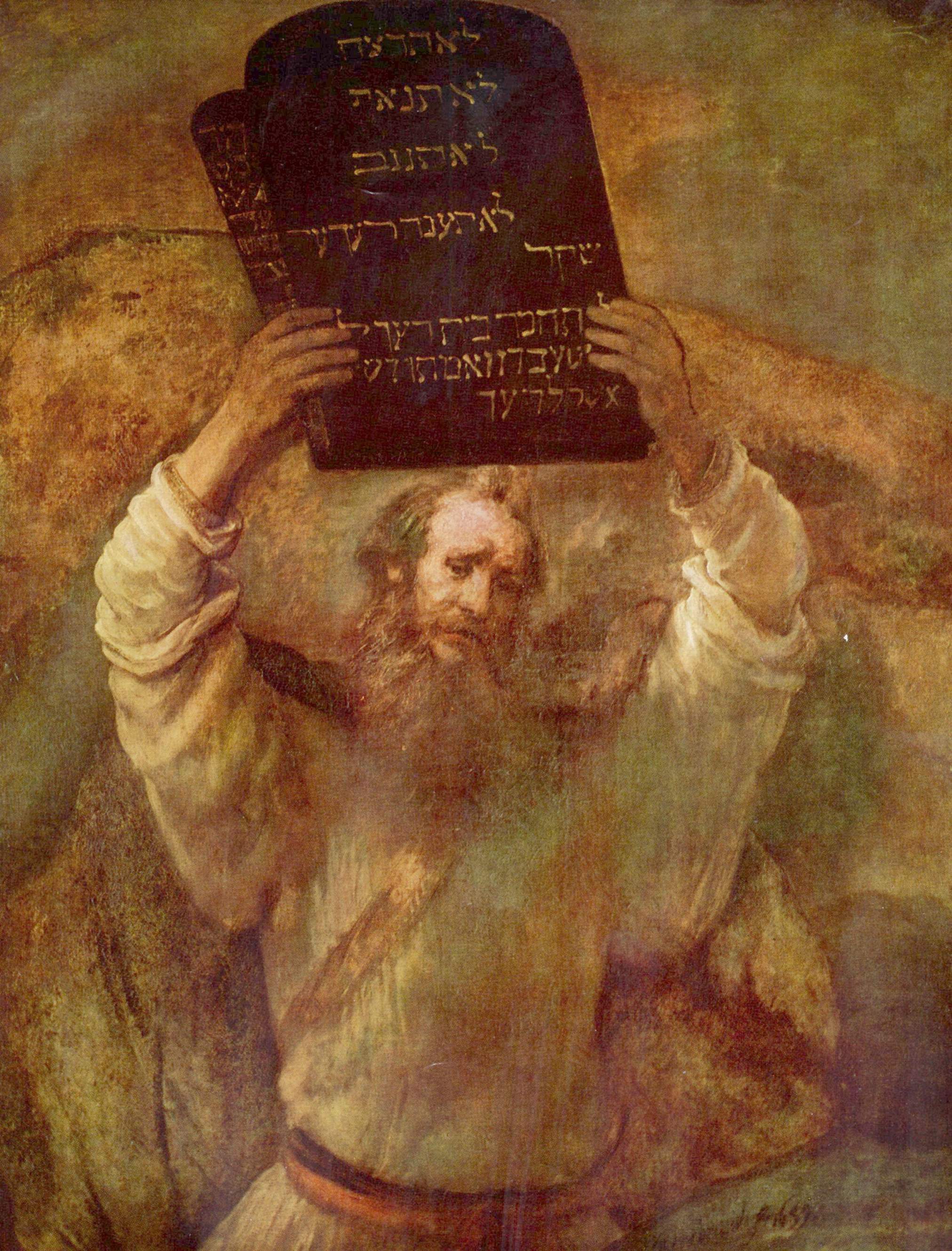
Then from verse six to twenty-four we hear vivid descriptions of how Israel has been "rebellious against the Lord" (v.7). The height of their rebelliousness takes place, ironically, while Moses is hearing from the Lord and receiving the Ten Commandments. Moses walks down the mountains and finds all of Israel involved in worshipping a golden calf. Moses then destroys the sinful object by burning it with fire, crushing it, and then "grinding it thoroughly , until it was reduced to dust," (v.21)*. Needless to say, Israel is guilty just as all other nations and people are.

So if we are all guilty, people and nations alike, why was Israel preserved while the Canaanites suffered judgment? Before that question is answered it's important to understand that oftentimes God will bring judgment against even his chosen people because of their sinfulness (the exile is one major example). But back to the original question: why not Israel here, if they are in fact rebellious? The answer is given to us in the last section of chapter nine. Here we read that Moses lies "prostrate" for forty days and forty nights interceding for Israel, so that God would not destroy Israel. He even reasons with God, saying that to destroy Israel would be to forget the "Abraham, Isaac and Jacob" (v. 27); secondly Moses reasons that God's name would be trampled by the pagans if he doesn't see the Israelites into the Promised Land. So Moses gives God two reasons to preserve Israel: (1) because of covenant, (2) and because of God's own name and reputation. Here many people would question God as truly sovereign because how can Moses 'reason' with an all-knowing sovereign God? I personally believe that God's plan was always to preserve them, and not to destroy them, therefore keeping the covenant and bringing glory to his name. The reason, I feel, God put the question to Moses: "should I destroy them?" was to challenge Moses to step up as God's appointed leader of the Israelites. If we understand this section of Deuteronomy in this light we see a sovereign God desiring that Israel's appointed leader develop a leader's heart by crying out for those he has been given to lead, here God's sovereign authority is never put into doubt.


*As an aside Moses here foreshadows Christ by: (1) serving as an intercessor between God and man, (2) and by ridding Israel of the manifestation of their sinfulness (the difference between Moses and Christ being that while Moses destroyed the manifestation of their sin Christ destroys the root of our sin by offering a sacrifice once for all time (Heb. ch. 9 v.23-28)

Saturday, April 01, 2006

Deuteronomy Chapter Eight: From Decadence to Decay


First, thanks to Matt for giving a solid post, articulate and well-crafted. Thanks. If anyone out there in the blogosphere thinks Matt should continue with me on this Exegetical journey through Deuteronomy give him some encouragement, by way of a comment on his last post.

If anyone knows a good picture for this post, let me know.

Now on to Chapter Nine & From Decadence to Decay.

At the height of a fruit's ripening process the last thing we might think would be that soon it will decay and be worthless. We might have this knowledge after seeing the process repeat many times but for someone who hasn't seen fruit go bad, it would seem that there would be no way to posit the completely 'other' end--that it's decay would follow it's decadence. Israel, never having seen affluence, does not stand at a vantage point where it can understand decadence and self-exaltation as the seeds of demise, however, God--via Moses--warns them, "Do not say about yourself, 'My power and my might have gotten me this wealth.' But remember the Lord your God, for it is he who gives you power to get wealth [...]" ( v.17-18), and then, "if you forget the Lord your God and follow other gods to serve and worship them, I solemnly warn you today you shall surely perish" (v.19). To continue with the horticultural metaphor, if Israel "forgets" that all things come from God they are akin to a fruit falling from the vine; they will ripen quicker but they will perish quicker too. The lesson that Israel needs to learn is what Jesus tells his disciples in the book of John, "apart from me you can do nothing" (ch. 15 v.5).

Moses tells Israel that they should, "Remember the long way that the Lord your God has led you these forty years [...]" (v. 2). We learn that God brought them the "long way" through the desert to "humble" and "test" them (v.2). The method God used to humble them was "by feeding [them] manna, with which you nor your ancestors were acquainted, in order to make you understand that one does not live by bread alone, but by every word that comes from the mouth of the Lord" (v.3). If Israel remembers this upon reaching the Promised Land they will never "exalt themselves" when they are at rest (v. 12-14). So Israel is called to a holy remembrance which is two-fold: (1) they must remember their God, (2) they must remember their humble beginnings so that they may see come to grips with the timeless truth that says, 'success, as the Bible sees it, is not a product of human ingenuity or force but humble faithfulness'. Both take root in the corporate acknowledgment that the Lord is sovereign and that he provides, or that he is the vine and we are the branches.

Thursday, March 30, 2006

Deuteronomy 7: Mysterious Grace

The conquest of Canaan is simultaneously an act of great love, and an act of great judgment by God. Great love on behalf of his chosen people, to give them a land flowing with milk and honey, a land of great influence in the region, and a land that would be theirs for generations to come. There would be great judgment on the Canaanites, the seven peoples greater and stronger than Israel; their perverse fertility religions had built up the wrath of God, which would soon be poured out through His instrument Israel. Great mercy would be shown to Israel, despite their wandering and whining, by giving them the land, taking it from the current residents. In the Bible, and by their nature, the grace and mercy of God are always undeserved. Conversely, in the Bible, the judgment of God is always deserved. Thus we can say that although undeserving, God blessed his chosen people, and because the Canaanites were deserving of wrath, he cursed them. What should make us wince when we read Deuteronomy 7 is not our human sense of justice being violated, but an awareness of our sinfulness like the Canaanite, and an awareness of how undeserving we are like an Israelite.

Even though we get a little sensitive about our “God of love” being so judgmental, his greatest act of love was an act of judgment. Where else do we see an act of great love and of great judgment in the Bible? At the cross we have the most loving event of all time, and also the worst, most unfair event of all time. In the judgment of God upon Jesus, we have life. In 1st Corinthians 5:21, it illustrates this great exchange and juxtaposition of judgment and love: “God made him who had no sin to be sin for us, so that in him we might become the righteousness of God.” The central event of salvation was the most unfair, inhumane event of all time.

Lest we minimize the history of Israel and God’s dealings with her to allegory and illustrations, let’s think about the results of the conquest of Canaan. First of all, the Israelites were successful in occupying the land, but they did not exterminate the Canaanites. To be sure, many were killed, but also many were dispersed, and some even intermarried with Israelites. Let us not forget Rahab, the Canaanite woman from Jericho who would be part of the line of Jesus. Secondly, in God’s mysterious ways of grace, we see Jesus in the gospels, consorting with Samaritans (Hebrew-Canaanite mix), and going to the Decapolis, at that time known as the “land of the seven” according to Jewish tradition. In a land considered evil, he cast out a legion of demons and set a man free, and then sent him to tell people what God had done for him. (For more on the Decapolis, see here. Jesus showed his disciples what the kingdom would be like. It would be much different than a tiny, sliver of a nation-state; they would bring his kingdom to the world. The kingdom would encompass the entire globe and take root in all the cultures and peoples of the earth.

Wednesday, March 29, 2006

In Process: St. Augustine's Confessions


I am currently reading through St. Augustine's Confessions with the other formal Quest member. In it Augustine makes some brilliant observations about his coming to faith, here is one thought he had upon beginning to read the Bible which had particular resonations with me.

"So I made up my mind to examine the holy scriptures and see what kind of books they were. I discovered something that was at once beyond the understanding of the proud and hidden from the eyes of children. Its gait was humble, but the heights it reached were sublime" (pg. 60 Penguin or 3:5).

For more info on Augustine click here for a good Wikipedia article.